
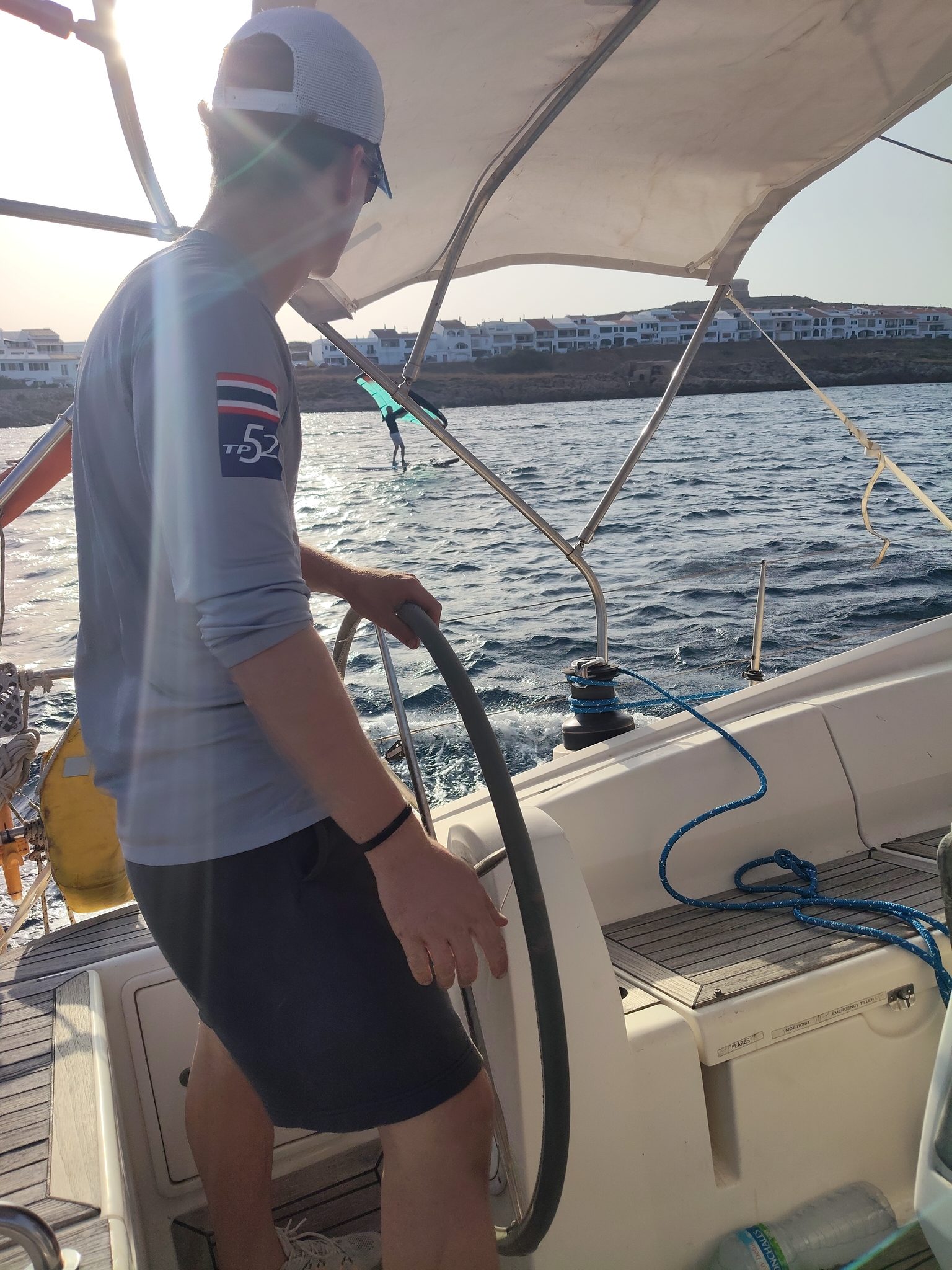
Competent Crew
Five days at sea covering seamanship, helmsmanship, sail handling, ropework, and safety.
Read the guide: RYA Competent Crew: your first step into sailingSyllabus Highlights
14 sections · 14 topics · 151 outcomes
Key topics & assessment areas
Prerequisite Knowledge
Before you book
No prior experience required. This course is suitable for complete beginners.
Level · beginner
Where we run it
Available locations
Fornells, Menorca
Menorca
RCMB, Barcelona
Barcelona
Enrollment
Enroll on Competent Crew
Enrolling creates your course record so you can follow the syllabus, access course materials, track competencies and book practical sessions when dates suit you.
Delivered by Mt Sail & Power. Questions before you start? sail@mtsail.com
Course tools
No Chart Room or practical exams are included with this course.
Course Content
What you'll cover
01Personal safety equipment and safety brief
Video3 lessonsOpenClose
Lifejackets, harnesses, clipping on, and the boat's safety brief.
Watch — training videos
Are distress signals out of date?
Know the distress kit on board
Yachting Monthly examines traditional flares versus modern electronic distress signals — what works, what is changing, and what to carry.
Video: Royal Yachting Association · Watch on YouTube
Lessons (3)
- Briefing: lifejackets, harnesses and the boat's safety gear45 min
- On deck: fitting kit, clipping on and moving safely60 min
- Debrief and self-check30 min
02Parts of the boat and nautical terminology
3 lessonsOpenClose
Naming the boat, her rig and gear, and using sea terms correctly.
Lessons (3)
- Briefing: hull, deck, rig, sails and sea terms45 min
- On the boat: naming gear and taking orders60 min
- Debrief and self-check30 min
03Ropework, knots and warps
Video3 lessonsOpenClose
The crew's knots, cleating, coiling, winches and handling mooring lines.
Watch — training videos
How to tie nine sailing knots
Watch before practising your knots on deck
Yachting Monthly demonstrates the nine essential sailing knots, bends and hitches every crew member should know, and where each is used on board.
Video: Royal Yachting Association · Watch on YouTube
Lessons (3)
- Briefing: knots, cleating and warps45 min
- On the boat: ropework, winches and mooring lines90 min
- Debrief and self-check30 min
04Crew duties underway
3 lessonsOpenClose
Working the deck: preparing to sea, tacking, gybing, lookout and the log.
Lessons (3)
- Briefing: preparing for sea, tacking and gybing45 min
- On the water: sheet work, gybes and lookout120 min
- Debrief and self-check30 min
05Sail setting, trimming and reefing
Video3 lessonsOpenClose
Hoisting, trimming to the telltales, reefing and stowing sails.
Watch — training videos
Are your sails past their best?
Understand what good sail shape looks like
Yachting Monthly explains how to tell when sails are past their best — stretched shape, worn cloth and stitching — and what to do about it.
Video: Royal Yachting Association · Watch on YouTube
Lessons (3)
- Briefing: sail shape, trim and reefing systems45 min
- On the water: hoisting, trimming and reefing drills120 min
- Debrief and self-check30 min
06Helming under sail and power
3 lessonsOpenClose
Steering to a compass course, to the wind and under engine.
Lessons (3)
- Briefing: steering by compass, wind and transit45 min
- On the water: helming under sail and power120 min
- Debrief and self-check30 min
07Man overboard and emergency procedures
Video3 lessonsOpenClose
The crew's part in an MOB recovery, distress calls and emergency gear.
Watch — training videos
MOB retrieval and recovery
See the recovery techniques from your MOB module in action
Yachting Monthly tests man overboard retrieval and recovery techniques afloat, showing what really works when getting a casualty back on board.
Video: Royal Yachting Association · Watch on YouTube
Lessons (3)
- Briefing: MOB drill, distress calls and emergency gear45 min
- On the water: MOB drills under power and sail120 min
- Debrief and self-check30 min
08Living aboard, watchkeeping and weather awareness
3 lessonsOpenClose
Watch systems, galley and heads, hygiene, and reading the weather as crew.
Lessons (3)
- Briefing: living aboard, watch systems and weather45 min
- Aboard: galley, heads, watchkeeping and forecast practice90 min
- Debrief and self-check30 min
09Fire precautions and firefighting
3 lessonsOpenClose
Preventing fire aboard, and the crew's response when one starts.
Lessons (3)
- Briefing: fire risks, prevention and extinguisher types40 min
- Aboard: locating gear and fire drills60 min
- Debrief and self-check30 min
10Rules of the road and lookout
3 lessonsOpenClose
The collision regulations a crew needs, lights, shapes and sound signals.
Lessons (3)
- Briefing: collision regulations, lights and sound signals45 min
- On the water: traffic calling and night light recognition90 min
- Debrief and self-check30 min
11Manners, customs and dinghy handling
Video3 lessonsOpenClose
Courtesy afloat, flag etiquette, and getting ashore safely by tender.
Watch — training videos
How to scull a dinghy
A handy tender skill for the dinghy-handling module
Yachting Monthly teaches sculling — propelling a dinghy with a single oar over the stern, an essential tender skill.
Video: Royal Yachting Association · Watch on YouTube
Lessons (3)
- Briefing: harbour manners, flag etiquette and tenders40 min
- Aboard: rafting, crossing boats and dinghy work90 min
- Debrief and self-check30 min
12Seasickness, comfort and wellbeing at sea
3 lessonsOpenClose
Preventing and managing seasickness, cold, heat and fatigue.
Lessons (3)
- Briefing: seasickness, cold, heat and fatigue40 min
- Aboard: kit, hydration and looking after each other60 min
- Debrief and self-check30 min
RYA Syllabus
Learning outcomes
01Knowledge of Sea Terms
2 outcomes
Terminology and parts2
- 1.1Uses correct nautical terminology for boat, rig and equipment
- 1.2Identifies parts of the hull, spars, sails and running/standing rigging
02Sail Handling
2 outcomes
Setting, reefing and handing2
- 2.1Prepares and hoists sails; reefs, shakes out and lowers under supervision
- 2.2Handles sheets and halyards on winches safely
03Ropework
2 outcomes
Knots and rope handling2
- 3.1Ties eight essential knots without hesitation
- 3.2Coils, secures, throws and heaves a line accurately
04Fire Precautions & Fire Fighting
1 outcomes
Onboard fire safety1
- 4.1Knows location and use of extinguishers, fire blanket and gas isolators
05Personal Safety Equipment
1 outcomes
PFDs, harnesses & jackstays1
- 5.1Dons a lifejacket and harness correctly; clips on when appropriate
06Man Overboard
1 outcomes
MOB response1
- 6.1Raises the alarm and performs the actions expected of crew during MOB drill
07Emergency Equipment
1 outcomes
Distress signals & liferaft1
- 7.1Knows location and purpose of flares, EPIRB and liferaft
08Manners and Customs
1 outcomes
Life aboard1
- 8.1Understands accepted behaviour with regard to rubbish, discharges, noise and privacy
09Rules of the Road
1 outcomes
IRPCS basics1
- 9.1Has a basic knowledge of the steering and sailing rules
10Dinghies
1 outcomes
Tender handling1
- 10.1Boards and disembarks a dinghy; rows or drives a tender safely
11Meteorology
1 outcomes
Wind and weather1
- 11.1Recognises Beaufort force and the effect of wind on the sea state
12Seasickness
1 outcomes
Prevention & care1
- 12.1Understands prevention, remedies and how to look after affected crew
13Helmsmanship and Sailing
2 outcomes
Steering under sail and power2
- 13.1Steers a compass course and by the wind, under sail and power
- 13.2Understands the effect of the rudder and propeller
14General Duties
2 outcomes
Anchoring, mooring & watchkeeping2
- 14.1Assists with anchoring, mooring and berthing
- 14.2Stands watch and keeps a lookout
Upcoming Sessions
Book your place
02 Nov, 08:00
ends 06 Nov, 16:00
📍 RCMB Barcelona
£0
6 / 6 spots left
12 Apr, 07:00
ends 16 Apr, 15:00
📍 RCMB Barcelona
£0
6 / 6 spots left
17 May, 07:00
ends 21 May, 15:00
📍 Fornells, Menorca
£0
6 / 6 spots left
14 Jun, 07:00
ends 18 Jun, 15:00
📍 Fornells, Menorca
£0
6 / 6 spots left
13 Sept, 07:00
ends 17 Sept, 15:00
📍 RCMB Barcelona
£0
6 / 6 spots left